Most Deltona homeowners schedule HVAC maintenance once a year — but many aren't sure what that actually involves. If you've ever wondered whether it's truly worth it or just a routine upsell, the answer lies in what a thorough tune-up actually uncovers. In Florida's subtropical climate, where AC systems run nearly every month of the year and humidity sits stubbornly above 70%, the stakes for a neglected system are far higher than in most of the country.
Deltona's unique environment — including oak pollen season, high particulate load from surrounding orange groves, and relentless summer heat — creates conditions that stress HVAC systems in ways that generic maintenance guides never account for. A professional tune-up here isn't about checking boxes. It's about catching the slow failures that Central Florida heat accelerates before they become expensive emergencies.
TL;DR Quick Answers
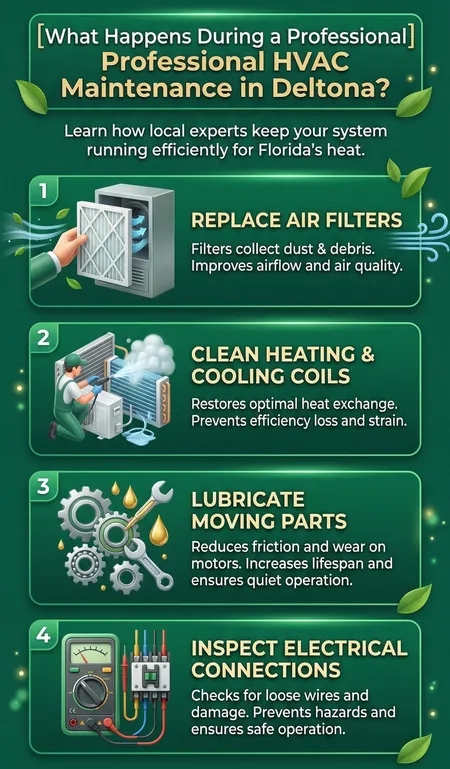
What Happens During a Professional HVAC Maintenance in Deltona?
A professional tune-up covers the full system — coils, drain lines, refrigerant levels, electrical components, and airflow — with the goal of catching small failures before they become expensive ones.
The full visit typically takes 60–90 minutes and is designed to extend system lifespan, maintain efficiency, and keep your home comfortable through Florida's demanding cooling season.
Top Takeaways
Florida's climate demands annual maintenance at a minimum. Year-round operation accelerates wear on every component.
Condensate drain flushing is non-negotiable in humid climates. Clogs cause water damage fast.
Capacitor testing predicts failures before they happen. A proactive replacement costs far less than an emergency call.
Coil cleanliness directly impacts efficiency. A dirty evaporator coil can reduce system efficiency by 30% or more.
Documentation matters. Tracking refrigerant levels and electrical readings year over year reveals trends no single visit can show.
What a Professional Technician Actually Does — Step by Step
Starts at the Thermostat, Not the Unit
A trained technician begins by testing the thermostat for accurate calibration. A thermostat that reads 74°F but triggers cooling at 76°F quietly costs you money every cycle. This step is quick but often skipped in lower-quality tune-ups.
Inspects and Cleans the Evaporator Coil
The evaporator coil sits inside your air handler. In Deltona's humidity, mold and microbial buildup on this coil is common — especially in homes where the filter isn't changed frequently. A dirty coil reduces heat transfer efficiency and can cause the unit to freeze up mid-summer.
Technicians clean the coil using a no-rinse foaming coil cleaner, then inspect the drain pan beneath it for standing water or algae buildup.
Flushes the Condensate Drain Line
This is one of the most important steps in Florida. Condensate drain lines clog with algae, mold, and debris — and a blocked drain line causes water backup that can damage ceilings, drywall, and flooring. Technicians flush the line with compressed air or a wet-dry vacuum and may treat it with algaecide tablets to slow future growth.
Checks Refrigerant Levels and Looks for Leaks
Low refrigerant is a performance killer. Technicians use gauges to measure system pressures and compare them to manufacturer specifications for the current outdoor temperature. If pressures are off, that points to either a refrigerant leak or a metering device issue — both of which require follow-up.
Adding refrigerant without finding the source of a leak is a temporary fix at best. A thorough technician documents the reading and recommends leak detection if pressures are consistently low year over year.
Tests Electrical Components
Capacitors and contactors fail more frequently in Florida because heat accelerates their degradation. Technicians use a multimeter to test capacitor microfarad ratings against acceptable tolerances. A capacitor reading more than 10% below its rated value is a predictive failure — it won't last another full season.
Contactors are visually inspected for pitting or burn marks, which indicate arcing damage that can eventually cause a no-start condition.
Cleans and Inspects the Condenser Unit
Outside, the condenser coil pulls heat out of the refrigerant and rejects it into the outdoor air. In Deltona, these coils collect cottonwood seeds, grass clippings, and oak pollen debris that restrict airflow. Technicians rinse the coil fins with low-pressure water and straighten any bent fins with a fin comb.
Reduced airflow across the condenser forces the compressor to work harder — raising discharge pressure, increasing energy consumption, and shortening compressor life.
Measures System Airflow
This step separates a comprehensive tune-up from a basic checkup. Technicians measure static pressure in the duct system and compare supply versus return air temperatures — called the "temperature split" or delta-T. A properly functioning system should produce a 16–22°F temperature difference across the coil. A split outside that range signals a problem with refrigerant charge, airflow, or coil cleanliness.
"In Deltona's climate, we're not just maintaining a machine — we're protecting a system that's been fighting Florida heat and humidity 365 days a year. The issues that catch homeowners off guard, like failed capacitors and clogged drain lines, are almost always predictable when you know what to look for and document system trends over time."
Essential Resources on "HVAC Maintenance in Deltona"
1. EPA Guide to Indoor Air Quality and HVAC Systems
The EPA's indoor air quality resources explain the connection between HVAC maintenance and household air quality, including how dirty systems spread contaminants throughout a home. https://www.epa.gov/indoor-air-quality-iaq
2. U.S. Department of Energy — Maintaining Your Air Conditioner
The DOE provides clear guidance on what homeowners and technicians should address during routine maintenance, including coil cleaning, filter replacement, and refrigerant checks. https://www.energy.gov/energysaver/maintaining-your-air-conditioner
3. ASHRAE — Standards for HVAC System Maintenance
ASHRAE establishes the industry technical standards that define proper HVAC maintenance procedures, including airflow measurement and refrigerant handling requirements. https://www.ashrae.org/technical-resources/bookstore/standards-62-1-62-2
4. Florida Department of Business and Professional Regulation — Contractor Verification
Before hiring any HVAC technician in Deltona, verify their Florida contractor license through the state's official licensing portal. https://www.myfloridalicense.com/wl11.asp
5. ENERGY STAR — Home Cooling Tips and Maintenance
ENERGY STAR offers homeowner-focused guidance on maintaining cooling efficiency, including when to schedule professional service and what to expect from a tune-up. https://www.energystar.gov/products/heating_cooling/heat_cool_equip_maintenance
6. CDC — Indoor Environmental Quality
The CDC addresses how HVAC systems affect indoor environmental quality and health, particularly relevant for households with allergy or asthma concerns. https://www.cdc.gov/niosh/topics/indoorenv/default.html
7. Air Conditioning Contractors of America (ACCA)
ACCA develops industry standards for HVAC installation, maintenance, and quality assurance — the professional benchmark that reputable contractors follow. https://www.acca.org/standards
Supporting Statistics
Up to 25% energy savings. The U.S. Department of Energy reports that regular HVAC maintenance can reduce energy consumption by up to 25%.
Source: https://www.energy.gov/energysaver/maintaining-your-air-conditioner
90% of time spent indoors. The EPA estimates Americans spend approximately 90% of their time indoors, where air pollutants can be 2–5 times higher than outdoor concentrations.
Source: https://www.epa.gov/report-environment/indoor-air-quality
$5,000–$12,000 replacement cost. The Department of Energy notes that proper maintenance can extend HVAC system lifespan by years, deferring replacement costs that typically range from $5,000 to $12,000 for a full system.
Source: https://www.energy.gov/energysaver/air-conditioning
What these numbers mean in Deltona specifically: a system running year-round accumulates more operating hours than the same system in a northern climate would in 18 months. That compressed wear cycle makes the energy savings and lifespan extension from annual maintenance here more valuable, proportionally, than the national averages suggest. Skipping one tune-up in Central Florida isn't equivalent to skipping one in Ohio — the compounding wear is simply greater.
Final Thought & Opinion
Professional HVAC maintenance in Deltona isn't a luxury — it's a practical response to an environment that's genuinely hard on mechanical systems. The combination of year-round operation, high humidity, biological growth in drain lines and coils, and heat-stressed electrical components creates a maintenance picture more demanding than most of the country faces.
The most valuable outcome of a thorough tune-up isn't what gets cleaned. It's what gets documented. A technician who measures your refrigerant pressures, tests your capacitors, and records system temperatures gives you a baseline — a year-over-year trend line that predicts failures before they strand your family in a hot house in July.
Choose a technician who brings gauges, not just a vacuum and a checklist. The difference in what they find — and what they prevent — is substantial.
FAQ on "HVAC Maintenance in Deltona"
Q1: How often should I schedule HVAC maintenance in Deltona?
A: Once per year is the standard recommendation.
In Deltona, twice yearly is worth considering.
Florida systems run year-round, accumulating wear faster.
Schedule one visit in spring before peak cooling season and one in fall.
Q2: What's included in a professional HVAC tune-up?
A: A complete maintenance visit covers:
Coil cleaning (evaporator and condenser)
Condensate drain flush
Refrigerant pressure check
Electrical component testing (capacitors, contactors)
Thermostat calibration
Filter inspection or replacement
Airflow and temperature split measurement
Q3: How long does an HVAC maintenance visit take?
A: Typically 60–90 minutes.
Older systems or units with significant buildup may take longer.
A visit under 45 minutes is unlikely to be thorough.
Q4: Can I do HVAC maintenance myself?
A: Some tasks are DIY-friendly:
Replacing air filters monthly or every 90 days
Keeping the outdoor condenser unit clear of debris
Pouring a cup of diluted bleach into the condensate drain monthly
However, refrigerant checks, electrical testing, and coil cleaning require a licensed technician and proper equipment.
Q5: What happens if I skip annual HVAC maintenance in Deltona?
A: The consequences compound quickly:
Condensate drain clogs cause water damage.
Dirty coils reduce efficiency and strain the compressor.
Failed capacitors lead to no-start emergencies, often on the hottest days.
Refrigerant leaks go undetected and worsen over time.
Overall system lifespan shortens by years, not months.
Schedule Your Maintenance Visit Today
Annual HVAC maintenance is one of the most cost-effective steps you can take to protect your home comfort and avoid unexpected repair bills. Don't wait for a breakdown to find out what your system needs.
Here is the nearest branch location serving the Deltona area. . .
Filterbuy HVAC Solutions
2900 Titan Row # 128, Orlando, FL 32809
(407) 204-1859
https://maps.app.goo.gl/1VWkzrEiCyb4sKPT7b
Here are driving directions to the nearest branch location serving Deltona. . .